Showing posts with label Non-fiction. Show all posts

Wednesday, 12 December 2018

"One-Way Street," by Walter Benjamin

Non-fiction, 1921-34

Cultural and philosophical essays written in Germany, in the early part of the twentieth century. As such, and as Benjamin was Jewish, these pieces are poignant. Much of their meaning and drift may puzzle the lay reader not especially versed in the period, nor particularly in philosophical writing. But still, the more accessible pieces on "Unpacking my Library" and "The Work of Art in the Age of Mechanical Reproduction", and the quips and aphorisms in the title essay have a good feel about them and are more easily digestible. Some period details baffle, though overall, there should be something for many readers here.

Tuesday, 11 December 2018

"Kingdom of Fear," by Hunter S Thompson

Non-fiction, 2003

A string of anecdotes told through different narratives and styles, including letters, transcriptions and articles. Thompson's typically irreverent, painting himself as an anarchist tear-about, blazing guns, elk hearts and managing a San Francisco strip club, always keeping one brutal step ahead of the establishment. There's a slew of famous and not-so-famous allies, hangers-on, chancers and acquaintances, all of whom are smudged into the frantic pace and paste of a Gonzo approach and a free spirit increasingly disbelieving in the post-Twin Tower political response and American landscape. Tougher to get through than some of Thompson's other books, but some great passages along the way. 

Wednesday, 22 August 2018

"Chavs: The Demonization of the Working Class", by Owen Jones

Non-fiction, 2011

Compelling account which does what the title suggests, setting out how the working class has been set apart and savaged by contemporary power bases. Jones makes his arguments clearly and backs them up, then repeats them before going back again and doing it all over again. The book flags as a result - this feels like a tight documentary spun into a mini-series. A book that's hard to disagree with, but outstays its welcome. In doing so, however, it presents some clear examples of social engineering and manipulation.

Friday, 20 July 2018

"The Year of Magical Thinking," by Joan Didion

Non-fiction, 2005

An account of Joan Didion's coping and mourning the death of her husband at a time when their daughter was also perilously ill. Didion's mixture of terror and bemusement when negotiating every day events and reminders feels detached at times until there's a crack in the narrative action or town, which suddenly brings the tragedy into sharp focus. This isn't a book with a big message or purpose, but its focus and very exact language give it a poise and sincerity and allows the reader to connect and project, to Didion and to wider experiences of loss.


Friday, 22 June 2018

"The Best Minds of my Generation," by Allen Ginsberg

Non-fiction, 2017

Write up of 1977 university course, surveying some of the Beat Generation's most celebrated practitioners. A curious, patchy, though ultimately rewarding mixture of biography (which is great) and literary criticism (a little less so - though probably something which would best work in an actual lecture). Sections on Jack Kerouac are particularly good, although the overall sense is of a serious look at a period of great creative energy and excitement, with boundaries pushed in fiction and poetry.


Monday, 30 April 2018

"Nairn's London," by Ian Nairn

Non-fiction, 1966

Idiosyncratic architectural guide to the capital, in which the excellently opinionated, self-taught Nairn takes the reader on a tour of the notable landmarks, in his eyes, in 1960s London. Descriptions of styles in suburban pubs rub shoulders with churches and the odd stately home and town centre. Nairn often doesn't make an awful lot of sense, but there's a real drive throughout the book, which has more than its fair share of jaw-dropping, satisfying and otherwise memorable moments, most notably when the writer is inclined to more pronounced displays of either joy or disdain.

Friday, 11 August 2017

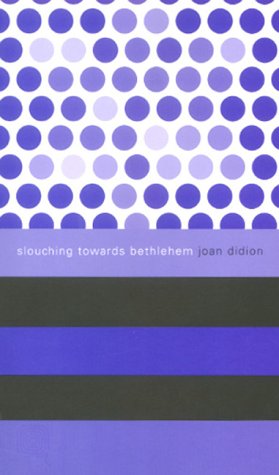
"Slouching Towards Bethlehem," by Joan Didion

Non-fiction, 1968

New Journalism without quite the crushing egotism and boorishness of either Hunter S Thompson or Tom Wolfe, focusing around a piece describing, in human terms, the human wreckage around Haight-Ashbury in the Summer of Love. This, and other pieces, are often wonderfully written, mixing an air of despair with one of nonchalance and painting an America roiling and clashing with itself and in no way showing any kind of social decorum. Refreshing change from the over-eulogising efforts of others, but still reportage of and within the moment.

Sunday, 3 January 2016

"The Big Midweek" by Stephen Hanley and Olivia Piekowski

Non-fiction, 2014

Sardonic, celebratory account of Stephen Hanley's two decades playing bass guitar for The Fall. It would have been quite easy for Hanley to have ranted, although in his balanced descriptions, band members are brought to life and what feel like balanced recollections are made. Highs comfortably balance the lows with a claustrophobic inevitability setting in from the early 1990s, at around the time Brix Smith then Martin Bramah left the band. Excellent writing; compulsive Fall fan reading.

Monday, 14 December 2015

"Chronicles: Volume One", by Bob Dylan

Non-fiction, 2004

Dylan picks a few key points in his career in producing this hybrid of memoir and autobiography in what, ultimately, is an engaging, entertaining and occasionally laugh-out-loud account. In telling his tale, the lyricism and atmosphere of his song writing is retained, although the detail is nonetheless present in hugely convincing observations and memories. And contained within are some interesting tidbits - the protest singer famously battling his spokesman for the generation status, with a hankering for his family and life on the high seas in his yacht.

Sunday, 27 September 2015

"H is For Hawk" by Helen Macdonald

Non-fiction, 2014

Curious, ambitious and successful interweaving of three narratives - the loss of a father, a meditation of TH White and his book The Goshawk and Macdonald's own struggles with training her own bird. Different sections will work better for some people than others; the training was enthralling and beautifully done, although for me, parts of the looking back at White felt a tad laboured. This is, however, an unflinching, and in being both a bold book and very readable, pulls off quite a feat.